Jardines verticales, más allá del paisaje
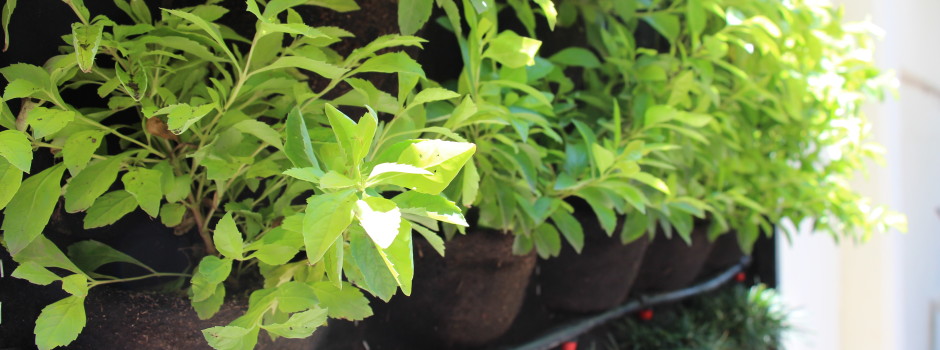
Aunado a su valor estético, un jardín vertical (o muro verde) tiene la capacidad de mejorar el ambiente al interior de las edificaciones al amortiguar el ruido y los cambios de temperatura; además, las plantas que sostiene absorben contaminantes atmosféricos y pueden convertirse en sitios de percha y alimentación para aves. A estos jardines y azoteas verdes se les denomina sistemas de naturación urbana y el objetivo de su instalación es mejorar la apariencia de las construcciones e imprimirles la idea “verde”, relacionada con la sostenibilidad ambiental. Debido a la importancia que tienen las áreas verdes para el equilibrio ambiental, la Organización Mundial de la Salud recomienda de 9 a 16 metros cuadrados de éstas por habitante en las urbes; sin embargo, la ciudad de México tiene, en promedio, 5.3 m2. “Este déficit tiene repercusiones en el bienestar de los individuos, pues la interacción con esos espacios reduce la ansiedad y la depresión”, afirmó Saraí Montes, investigadora del Instituto de Ecología (IE) de la Universidad Nacional Autónoma de México. Ante esa situación y la carencia de espacios, los jardines verticales serían un elemento adecuado para mejorar el bienestar de los habitantes, pues funcionan como barrera acústica al simular un colchón que aísla el ruido, principalmente por la porosidad de los sustratos (capa de tierra) y el follaje de las plantas. Con una combinación apropiada se puede alcanzar hasta 100% de aislamiento; ésta sería una opción para los habitantes de las delegaciones y municipios cercanos al Aeropuerto Internacional de la ciudad de México, acotó. Otra de sus bondades es la absorción de contaminantes a través de las estomas de las hojas: “Estos pequeños poros permiten el intercambio de dióxido de carbono (CO2), oxígeno (O2), vapor de agua y la entrada de contaminantes como los óxidos de nitrógeno, derivados de la combustión”. Si esos espacios se disponen de manera encontrada, uno frente a otro, generan una especie de túnel donde el aire recircula por las hojas de las plantas; entonces, la absorción de contaminantes se potencia. Además, las paredes verdes favorecen la presencia de aves, gorriones y estorninos, que utilizan estos sistemas para sus nidos y alimentarse de los insectos. Jorge Escutia, también biólogo del IE, consideró relevante incentivar en los sistemas de naturación el uso de flora nativa, así como sensibilizar a los propietarios u observadores sobre los cambios fenológicos de las plantas, es decir, que no siempre tendrán la misma apariencia verde o con follaje, “por lo que debemos apreciar los aspectos estacionales y de crecimiento”. Desde 1988, los jardines verticales han cubierto áreas europeas, gracias a la técnica patentada de Patrick Blanc, biólogo francés que aplicó sus conocimientos en botánica para crear espacios monumentales. Con base en ello, Ulises Martínez, egresado de la Facultad de Ingeniería, emprendió la comercialización de aquéllos a través de la empresa Naturación Integral, incubada en InnovaUNAM y financiada parcialmente por el Consejo Nacional de Ciencia y Tecnología. Cuenta con la vinculación del Colegio de Postgraduados de Chapingo y del IE, donde Saraí y Jorge colaboran. Como resultado de esta asociación se han instalado dos jardines en la entidad universitaria, uno con plantas nativas del Valle de México y otro, experimental, que apoya el desarrollo de una tesis de maestría. Con el primero se pretenden mejoras en el sistema al hacerlo menos costoso, seleccionar especies adecuadas para jardines de exterior e interior, y diseñar y probar sustratos y fórmulas de nutrición, detalló Martínez. La instalación de ese jardín vertical consistió en un bastidor de hierro sobre el cual se fijó una placa impermeable de plástico y aluminio reciclado que aísla y protege el muro de la humedad. Dos capas de geotextil, una tela plástica que permite el crecimiento de las raíces y la filtración del agua; finalmente, se colocó una mezcla de sustratos que brinda retención de humedad, así como buen drenaje y sostén a la raíz. Finalmente, comentó que éste es un ejemplo de cómo los universitarios pueden generar negocios y trabajar en colaboración con otros profesionistas para resolver aspectos técnicos de los sistemas de naturación. Periódico El Occidental
Vertical gardens, beyond the landscape
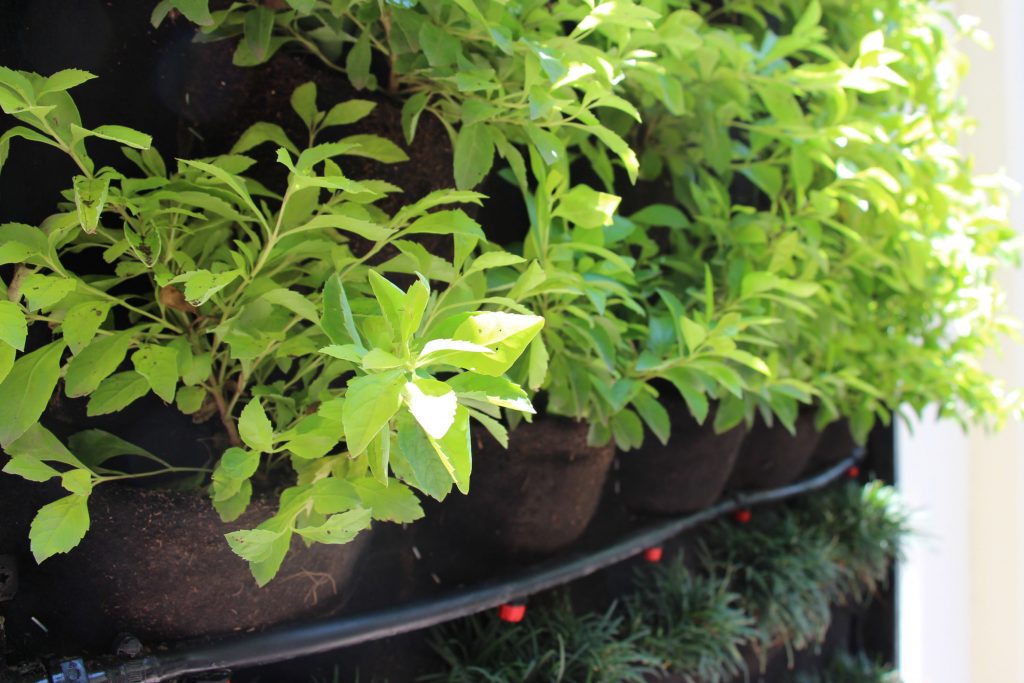
In addition to its esthetic value, a vertical garden (or green wall) has the ability to improve the environment within buildings by reducing the noise and temperature changes; besides, the plants it holds absorb atmospheric pollutants and may turn into bird’s perching and feeding places. These gardens and green rooftops are called urban naturation systems and its installation objective is to improve the appearance of the constructions and bring to them the «green» idea, related with environmental sustainability. Due to the importance these green areas have for the environmental balance, the World Health Organization recommends from 9 m2 to 16 m2 of them per resident in metropolis; despite this, Mexico City has an average of 5.3 m2. «This deficiency has implications for the welfare of individuals, since the interaction with those spaces reduces anxiety and depression», affirmed Saraí Montes, researcher at the Institute of Ecology (IE, Instituto de Ecología) of the National Autonomous University of Mexico (UNAM, Universidad Nacional Autónoma de México). Before this situation and the lack of spaces, vertical gardens would be a suitable element to improve residents’ welfare, because they function as an acoustic barrier by simulating a mattress which isolates the noise, mainly due to substratum’s porosity (layer of soil) and plant’s foliage. With an appropriate combination, 100% of isolation may be reached; this could be an option for the residents of municipalities near the International Airport of Mexico City, added. Another of its advantages is the absorption of contaminants through leaves’ stomata: «These small pores allow the exchanging of carbon dioxide (CO2), oxygen (O2), water steam and the entrance of contaminants as nitrogen dioxides, derived from combustion». If these spaces are arranged facing each other, they generate a tunnel where the air recirculates by the leaves of the plants; so, the absorption of contaminants is potentiated. In addition, green walls favor the presence of birds, sparrows and starlings, which use these systems for their nests and to feed from the insects. Jorge Escutia, also a biologist at the IE, considered relevant to incentivize in naturation systems the usage of native flora, as well as to sensitize owners and observers about phenological changes of the plants, that is, they won’t always have the same green appearance or foliage, «which is why we should appreciate the seasonal aspects and also those of growth». Since 1988, vertical gardens have covered European areas, thanks to the patented technique of Patrick Blanc, French biologist who applied his knowledge in botany for the creation of monumental spaces. On that basis, Ulises Martínez, graduate from the Faculty of Engineering, undertook the commercialization of green walls through the enterprise Integral Naturation (Naturación Intergal), incubated at InnovaUNAM and partially funded by the National Council of Science and Technology. It is linked to the Chapingo College of Postgraduates and the IE, where Saraí and Jorge collaborate. As a result of this association, two gardens have been installed in the university entity, one with native plants from the Mexico Valley and another, experimental, which supports the development of a master thesis. With the first one, improvements are expected by making the system less expensive, selecting appropriated species for outdoor and indoor gardens, and also by designing and testing substrata and nutritional formulas, detailed Martínez. That vertical garden’s installation consisted on an iron frame on which was fixed a waterproof plate made of plastic and recycled aluminum, which isolates and protects the wall from moisture. Two layers of geotextile, a plastic fabric which allows the growth of roots and water filtering; finally, there was placed a mixture of substrata which provides humidity retention, as well as good drainage and support to the root. By last, he commented that this is an example of how university people may generate business and work in collaboration with other professionals in order to resolve technical aspects of naturation systems. Source: El Occidental journal. http://www.oem.com.mx/eloccidental/notas/n3641124.htm. Translated by Belem Ruiz (Edition and Communication, PIT-UAS).
Niños aprenden y se divierten durante charla-taller y demostración sobre háptica y teleoperación
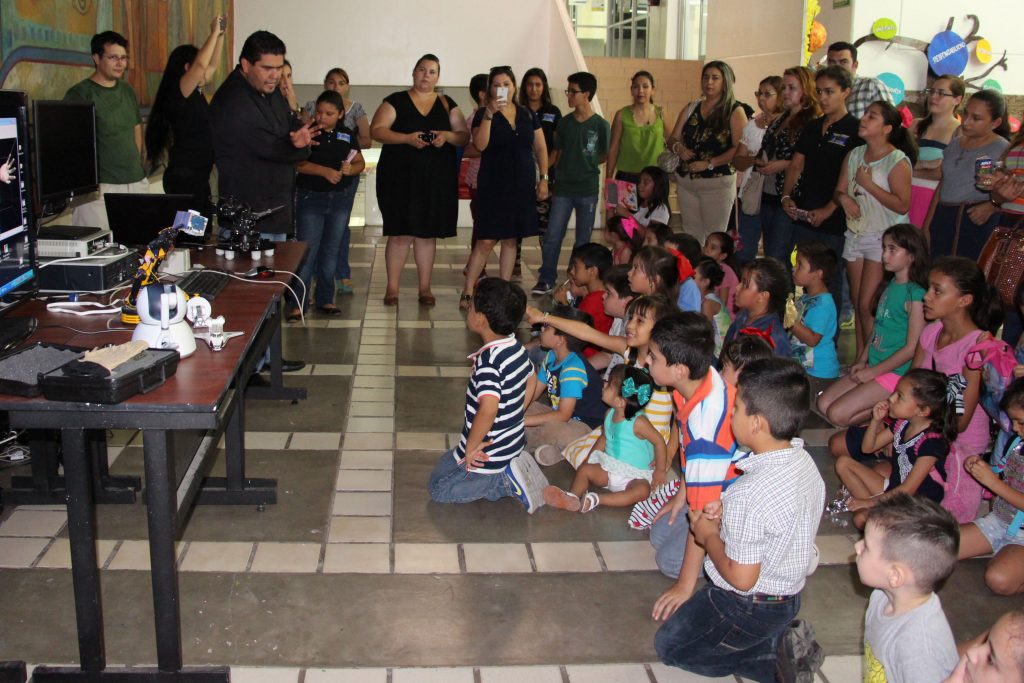
El jueves 2 de julio, decenas de niños de preescolar y primaria, acompañados por sus padres, asistieron a una charla-taller que versó sobre algunas herramientas robóticas y de realidad virtual que los astronautas emplean en el espacio, la cual estuvo a cargo de Ulises Zaldívar, doctor en Robótica por la Universidad de Versailles e investigador de tiempo completo en el Parque de Innovación Tecnológica (PIT) de la Universidad Autónoma de Sinaloa (UAS). Esta demostración, La Robótica como Herramienta Indispensable en la Era Espacial, formó parte de las actividades programadas dentro de la décima edición de los cursos de verano Mis Vacaciones en la Biblioteca, cuyo tema principal este año fue “Valores en acción: una aventura en el espacio” y son llevados a cabo por la Dirección General de Bibliotecas de la UAS y la Unidad de Bienestar Universitario. Reunidos afuera de las instalaciones de la Biblioteca Central de la UAS, los asistentes aprendieron sobre háptica y teleoperación. El doctor Zaldívar precisó que la teleoperación es una técnica que, mediante el uso de robots, permite realizar lo mismo operaciones microscópicas que a distancia, así sea en la misma área de trabajo o a kilómetros del operador humano; en tanto que la háptica es una tecnología que, a través del retorno de fuerzas, permite percibir e interactuar mediante el sentido del tacto con los elementos que constituyen una realidad virtual dada. Durante la demostración asistieron al doctor los maestros en Ciencias Paúl Tamayo y Silvestre Tamayo, a quienes dirige en la elaboración de sus tesis como maestrantes de Ciencias de la Información en la Facultad de Informática de la UAS y asimismo dentro del área Robótica y Realidad Virtual del PIT-UAS, donde apoyan a Zaldívar en el desarrollo y la aplicación de sus investigaciones. Los hermanos Tamayo se dedican, respectivamente, al desarrollo de técnicas de realidad aumentada para el ensamblaje virtual y a la investigación sobre una nueva estrategia de teleoperación para robots que permita integrar los movimientos naturales de las personas a fin de manipular a los autómatas. Bajo la supervisión de Silvestre y Paúl, los pequeños tuvieron la oportunidad de emplear la interfaz háptica Phantom, gracias a lo cual los niños constataron que medios para la operación a distancia como éste facilitan la realización de acciones específicas debido a que hacen que la interacción con un entorno virtual parezca más natural o real a través del retorno de fuerzas. Al respecto, cabe destacar la habilidad que mostraron los más pequeños, en comparación con los adultos, para interactuar con la interfaz. Los asistentes también conocieron a Nao, un pequeño robot interactivo que, previa programación, se presentó: “Me llamo Legabot, pero todos me dicen Nao”. Luego, aderezando sus intervenciones con gestos y movimientos que reforzaban sus palabras, el autómata entabló conversación con algunos niños y adultos del público. Así, sorprendidos y muy divertidos, ante la pregunta sobre su nacionalidad, los infantes escucharon responder a Nao: “Soy de Francia, pero me siento todo un mexicano”; otra de las preguntas hechas al robot fue en torno a su situación sentimental: “No, aún no tengo novia”, replicó Nao a la pregunta de uno de los pequeños. De esta forma, en complemento a la observación del Universo a través de telescopios y una visita guiada al Centro de Ciencias de Sinaloa, entre otras actividades de Mis Vacaciones en la Biblioteca, personal del PIT-UAS coadyuvó en la importante tarea de hacer que los niños conozcan las aplicaciones que la ciencia y la tecnología tienen en elementales esferas de las actividades humanas, con el propósito de generar un primer acercamiento de la infancia sinaloense a estos trascendentes campos del saber, y despertar así en estos infantes el interés por ellos. Comunicación Social PIT-UAS
Children learn and have fun during the talk-workshop and demonstration about haptic and teleoperation
On Thursday 2nd of July, tens of kindergarten and elementary school children, accompanied by their parents, attended to a talk-workshop about some of the robotic and virtual reality tools astronauts use in the outer space, which was on charge of Ulises Zaldívar, PhD in Robotics by the University of Versailles and full-time researcher at the Technological Innovation Park (PIT, Parque de Innovación Tecnológica) of the Autonomous University of Sinaloa (UAS, Universidad Autónoma de Sinaloa). This demonstration, Robotics as an Indispensable Tool in the Space Age, was part of the programed activities of the tenth edition of the summer courses My Vacations at the Library, which main subject this year was «Values in action: an adventure in the outer space» and are carried out by the UAS’ General Direction of Libraries and the University Welfare Unit. Gathered outside the facilities of the UAS’ Central Library, the attendees learned about haptic and teleoperation. PhD Zaldívar specified that teleoperation is a technique that, through the usage of robots, allows to realize everything from microscopic operations to remote operation, either in the same work area or kilometers away from the human operator; whereas haptic is a technology that, through force feedback, makes possible perceiving and interacting by the sense of touch with the elements that constitute a given virtual reality. MS Pául Tamayo and MS Silvestre Tamayo were attendants during the demonstration, both are current students of the Mastery of Sciences in Information at UAS’ Informatics Faculty and are elaborating their thesis directed by PhD Zaldívar; they also attend him within the PIT-UAS’ Robotics and Virtual Reality area, where they support Zaldívar in the development and application of his researches. The Tamayo brothers are respectively dedicated to the development of augmented reality techniques for the virtual assembly and to the research about a new strategy of teleoperation for robots that allow to integrate people’s natural movements, with the purpose of handle automatons. Supervised by Silvestre and Paúl, the children had the opportunity of employing the haptic interface Phantom, thanks to which the attendees confirmed that means for remote operation like this make easier the realization of specific actions because they make the interaction with virtual environments seem more natural or real through force feedback. On this subject, it is worth remarking the ability showed by the most little, in comparison to adults, to interact with the interface. The attendees also met Nao, a small interactive robot which, previous programming, introduced himself: «My name is Legabot, but everybody calls me Nao». Then, garnishing its interventions with gestures and movements that reinforced its words, the automaton had conversations with some children and adults from the audience. This way, amazed and very amused, when asked about its nationality, the infants heard Nao respond: «I am from France, but I feel a whole Mexican»; another question made to the robot was about its sentimental status: «No, I don’t have a girlfriend yet», replied Nao to one of the children’s inquiries. Thereby, in complement to the observation of the Universe through telescopes and a guided visit to the Sinaloa Science Center, among other activities of My Vacations at the Library, personnel of the PIT-UAS helped in the important task of making children know about science and technology applications in elementary spheres of human activities, with the objective of generating a first approach of Sinaloa’s children to these transcendent fields of knowledge, and thus awake in them an interest by such matters. Written by Moroni Arellano (Communication and Diffusion, PIT-UAS), translated by Belem Ruiz (Edition and Communication, PIT-UAS).
Estudiantes de la FCFM y de la FCQB desarrollan impresora 3D que funcionará con material PET
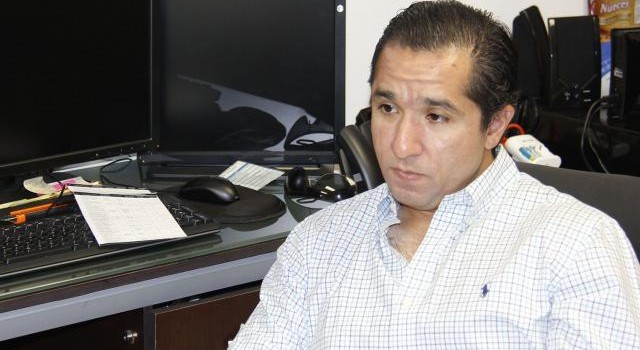
Estudiantes de la Universidad Autónoma de Sinaloa (UAS) confluyen en el Parque de Innovación Tecnológica (PIT) para desarrollar el Sistema de Automatización para el Proceso de Reciclaje de Material Plástico para la Modelación e Impresión 3D, dio a conocer José Ramón López Arellano, quien explicó que dicho sistema consiste en una impresora que puede estar funcionando con material polietileno tereftalato (PET) reciclado, el cual es un material fuerte, de peso ligero y de poliéster claro. El director del PIT-UAS indicó que los estudiantes cuya idea es generar esta impresora son alumnos de la licenciatura en Electrónica, de la Facultad de Ciencias Físico-Matemáticas, y alumnos de la Facultad de Ciencias Químico-Biológicas. El investigador universitario expuso que este proyecto incluye también la generación de la materia prima: “Estaríamos hablando de la generación de dos máquinas, una que produzca la materia prima y otra, el prototipo final impreso”. Para finales de año, dijo, se prevén los prototipos de estas dos máquinas, que estarían en condiciones de esperar una convocatoria de algún organismo como el Consejo Nacional de Ciencia y Tecnología (CONACyT) para bajar recursos y pulir dichos modelos. En este sentido, López Arellano comentó que los estudiantes, en sus ratos libres, trabajan en plasmar la idea en papel y tener un bosquejo actualizado para cuando se convoque por parte de CONACyT u otros organismos; empero, aclaró, se está trabajando también en los laboratorios del PIT-UAS para la modelación de tales prototipos. El desarrollo de las técnicas de impresión 3D es un área incipiente en el mercado, así como el desarrollo tecnológico de diferentes métodos, formas y complementos en la materia, finalizó José Ramón López Arellano. Dirección de Comunicación Social UAS
Students from FCFM and FCQB develop a 3D printer which will work with PET material
Students from the Autonomous University of Sinaloa (UAS) converge at the Technological Innovation Park with the purpose of developing the Automation System for the Process of Recycling Plastic Material for 3D Modeling and Printing, this was made known by José Ramón López Arellano, who explained that such system consists on a printer that functions with recycled polyethylene terephthalate (PET), which is a strong material, of light weight and clear polyester. The Director of the PIT-UAS indicated that these youths, whose idea is to generate this print, are current students of the degree in Electronics, from the Faculty of Physical-Mathematical Sciences (FCFM, Facultad de Ciencias Físico-Matemáticas), and from the Faculty of Chemical-Biological Sciences (FCQB, Facultad de Ciencias Químico-Biológicas). The university researcher detailed that this project also includes the raw material generation: «We’d be talking about the generation of two machines, one to produce the raw material and the other, the printed final prototype». By the end of the year, he said, it is planned to have the prototypes of these two machines, which would be in the conditions of waiting for some organism’s call, like the National Council of Science and Technology (CONACyT), to get the resources and to perfect such models. In this sense, López Arellano commented that the students are working during their free time on expressing the idea on paper, in order to have an updated sketch by the time calls from CONACyT or other organisms begin; nevertheless, he explained, there’s also work being done in the PIT-UAS’ laboratories for the modeling of such prototypes. The development of 3D techniques of print is an incipient area of the market, as well as the technological development of different methods, ways and complements in the matter, concluded José Ramón López Arellano. Source: Direction of Communications UAS. http://dcs.uas.edu.mx/index.php?sec=3&op=2&tipo=i&id_noticia=5797. Translated by Belem Ruiz (Edition and Communication, PIT-UAS).
Con presencia de la UAS, se lleva a cabo la instalación de la Mesa de Coordinación del Proyecto México Conectado en Nuevo León
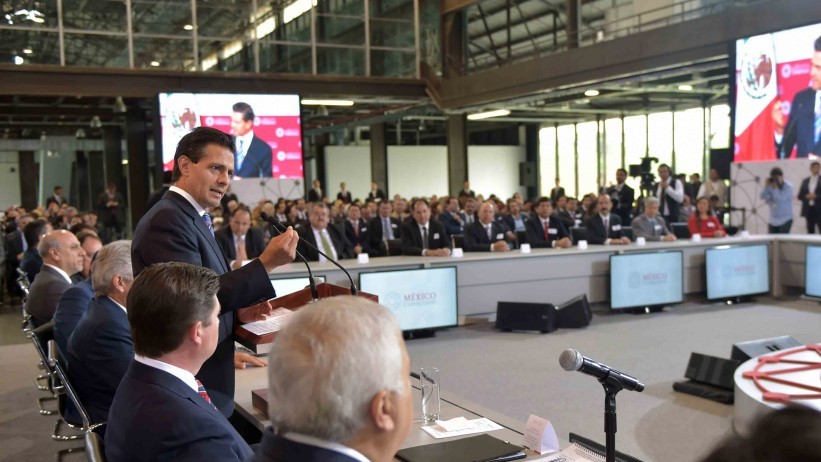
El pasado 6 de abril, con la presencia de José Ramón López Arellano, director del Parque de Innovación Tecnológica de la Universidad Autónoma de Sinaloa (UAS), en representación del rector, el doctor Juan Eulogio Guerra Liera, se llevó a cabo la instalación de la Mesa de Coordinación del Proyecto México Conectado (PMC) en el estado de Nuevo León. De este modo, Nuevo León se convierte en el decimoquinto estado en sumarse a este programa federal, cuyo objetivo es reducir la brecha digital existente en el país, mediante la promoción del acceso al servicio de internet de banda ancha de manera gratuita en escuelas, hospitales, clínicas, bibliotecas, centros comunitarios, oficinas de gobierno, parques, plazas, entre otros espacios públicos. La instalación de la Mesa de Coordinación, que se llevó a cabo en el Centro de Exposiciones Nave Lewis del Parque Fundidora —primer espacio público beneficiado con internet gratuito del PMC—, estuvo encabezada por Enrique Peña Nieto, presidente de la República, y Rodrigo Medina de la Cruz, gobernador del estado de Nuevo León. Peña Nieto señaló que a la fecha existen ya 65 mil espacios públicos conectados a internet, de los 250 mil que mandata la Constitución; se pretende llegar a la meta trazada para este año de 100 mil espacios públicos conectados. Agregó que México ha logrado una mayor conexión a internet móvil, al pasar la población que cuenta con acceso a este servicio de 21% a 40%. Además, aseguró que su gobierno trabaja para que los mexicanos tengan herramientas sólidas para poder contar con acceso a las tecnologías de la información, prueba de ello es que actualmente 47.4 millones de personas pueden acceder a internet de manera libre. En el evento también estuvieron presentes la maestra Mónica Aspe Bernal, titular de la Coordinación de la Sociedad de la Información y el Conocimiento, instancia responsable de la operación del Proyecto desde la Secretaría de Comunicaciones y Transportes (SCT); Gerardo Ruiz Esparza, secretario de la SCT; Emilio Chuayffet, secretario de Educación Pública; Alfonso Navarrete Prida, secretario del Trabajo; rectores de las universidades, entre otros. Este acto forma parte de los esfuerzos que contribuyen a garantizar el derecho constitucional de acceso al servicio de internet de banda ancha, que describe el artículo 6° de la Constitución Política de los Estados Unidos Mexicanos, se da así fe del interés del Gobierno federal por disminuir la brecha digital existente en el país. Comunicación Social PIT-UAS
With UAS presence, installation of the Connected Mexico Project’s Coordination Committee is performed
On April 6th, with the presence of the MBA José Ramón López Arellano, Director of the Technological Innovation Park of the Autonomous University of Sinaloa (UAS), on behalf of the Rector, PhD Juan Eulogio Guerra Liera, the installation of the Coordination Committee of the Connected Mexico Project (PMC, Proyecto México Conectado) was carried out in Nuevo León State. Thereby, Nuevo León becomes the 15th state joining to this federal program, which objective is to reduce the existent digital gap in the country, by promoting the free access to broadband internet service in schools, hospitals, clinics, libraries, community centers, governmental offices, parks, squares, among other public spaces. Coordination Committee’s installation, performed in the Exhibition Center Lewis Industrial Unit of the Fundidora Park —first public space benefited with free internet by the PMC—, was leaded by Enrique Peña Nieto, President of the Republic, and Rodrigo Medina de la Cruz, Governor of the Nuevo León State. Peña Nieto pointed out that up to today there are already 65 thousand public spaces connected to internet, of the 250 thousand the Constitution commands; it is intended to reach the objective of 100 thousand public spaces connected this year. He added that Mexico has reached a greater mobile internet connection, going from 21% to 40% regarding to population with access to this service. Besides, he claimed that his government works so the Mexicans can have the required solid tools to have access to information technologies, proof of this is that currently 47.4 millions of people can access to internet for free. At the event also were present the MPS Mónica Aspe Bernal, principal of the Coordination of the Information and Knowledge Society, instance responsible of operating the Project, from the Secretariat of Communications and Transportation (SCT, Secretaría de Comunicaciones y Transportes); Gerardo Ruiz Esparza, SCT’s Secretary; Emilio Chuayffet, Public Education Secretary; Alfonso Navarrete Prida, Work Secretary; university rectors, among others. This act is part of the efforts that contribute to guarantee the constitutional right to have access to broadband internet service, described in the sixth article of the Political Constitution of the Mexican United States. This way, the Federal Government’s interest on decreasing the existent digital gap in the country is demonstrated. Written by PIT-UAS’ Communication Team, translated by Belem Ruiz (Edition and Communication, PIT-UAS).
El PIT-UAS forma parte de la Red de Innovación del INADEM
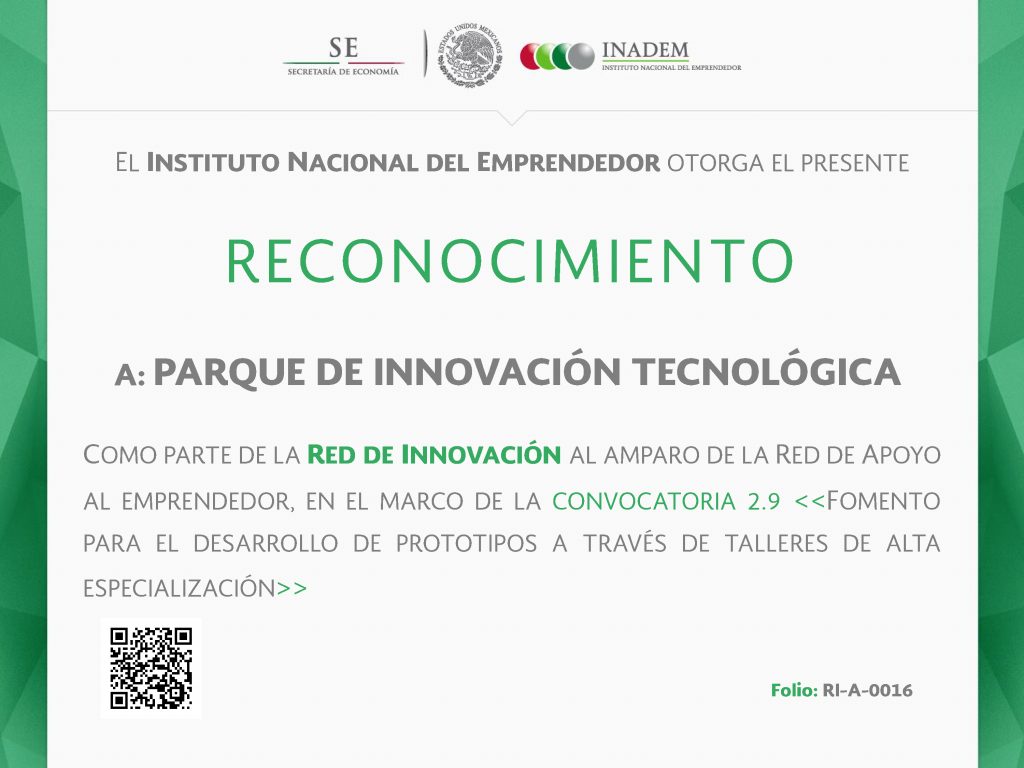
El Parque de Innovación Tecnológica (PIT) de la Universidad Autónoma de Sinaloa (UAS) forma parte de la Red de Innovación del Instituto Nacional del Emprendedor (INADEM) de la Secretaría de Economía federal, lo que da certeza y seguridad a los empresarios para solicitar recursos especializados, con el aval de una institución educativa. El director del PIT-UAS, maestro José Ramón López Arellano, aseguró que los laboratorios con los que cuenta la institución que preside están certificados. Además, comentó que las convocatorias especializadas y la vinculación entre empresa e institución educativa fomentan el modelo de trabajo conocido como triple hélice, con lo que se da la posibilidad de desarrollar prototipos que puedan ser comercializados. Recordó que, para formar parte de esta Red de Innovación, el Parque aplicó para la convocatoria que lanzó el INADEM denominada Fomento para el Desarrollo de Prototipos a través de Talleres de Alta Especialización: “Gracias a que formamos parte de esta red de innovación, ya se han acercado tres empresas de Jalisco, Chihuahua y Sinaloa, cuyas propuestas de proyecto están enfocadas a la generación de energía sustentable”. Aclaró que el PIT-UAS no sólo se enfoca al desarrollo de software, y que la Universidad, como tal, tiene diferentes áreas de oportunidad y áreas de conocimiento: “Todo el año estamos trabajando en conjugar los equipos multidisciplinarios, involucrando a diferentes facultades, y es gracias a esto que hemos podido formar tales equipos”. José Ramón López Arellano afirmó que el posicionamiento del PIT-UAS en el estado, la región y a nivel nacional, se debe al apoyo incondicional del rector de la Casa Rosalina, doctor Juan Eulogio Guerra Liera, con el cual se ha podido realizar la planeación adecuada en casi un año de operaciones. Finalmente, aseguró que en este camino de innovación se están cerrando filas, con coordinación y planeación, para salir a las facultades de todo el estado, e identificar las áreas de oportunidad y sus fortalezas, para conjugar equipos multidisciplinarios de ciencia básica con investigación aplicada. Dirección de Comunicación Social UAS
The PIT-UAS is part of the INADEM’s Innovation Network
The Technological Innovation Park (PIT, Parque de Innovación Tecnológica) of the Autonomous University of Sinaloa (UAS, Universidad Autónoma de Sinaloa) is now part of the Innovation Network of the National Institute of the Entrepreneur (INADEM, Instituto Nacional del Emprendedor), which belongs to the federal Secretariat of Economy. This achievement of the Park provides to entrepreneurs the certainty and safety to request specialized resources with the guarantee of an educative institution. The Director of the PIT-UAS, MBA José Ramón López Arellano, assured that the laboratories on which the institution he presides counts are certified. Besides, he commented that the specialized calls and the linkage between enterprise and educative institution promote the work model known as triple helix, with what is given the possibility of developing projects that may be commercialized. López Arellano recalled that, in order to be part of this Innovation Network, the Park applied for the call launched by the INADEM named Promotion for the Development of Prototypes via High Specialization Workshops: «Thanks to our belonging to this innovation network, three enterprises from Jalisco, Chihuahua and Sinaloa have already approached to us, which projects proposals are focused on sustainable energy generation». He explained that the PIT-UAS does not only focus on software development, and that the University, as such, has different opportunity areas of knowledge: «All year long we are working in forming multidisciplinary teams, involving different faculties, and it is thanks to this that we have been able to form such teams». José Ramón López Arellano affirmed that PIT-UAS’ position in the State, the region and the country is due to the unconditional support given by the University’s Rector, PhD Juan Eulogio Guerra, with which it has been possible the adequate planning in almost a year of operations. Finally, he claimed that ranks are being closed in this path of innovation, with coordination and planning, in order to visit the faculties in the whole state, identify the opportunity areas and its strengths, so multidisciplinary teams of basic science can be joint with applied research. Source: http://dcs.uas.edu.mx/index.php?sec=1&op=2&id_nota=5617&tipo=i. Translated by Belem Ruiz (Edition and Communication, PIT-UAS).