Recycling technology for 3D printing material is developed
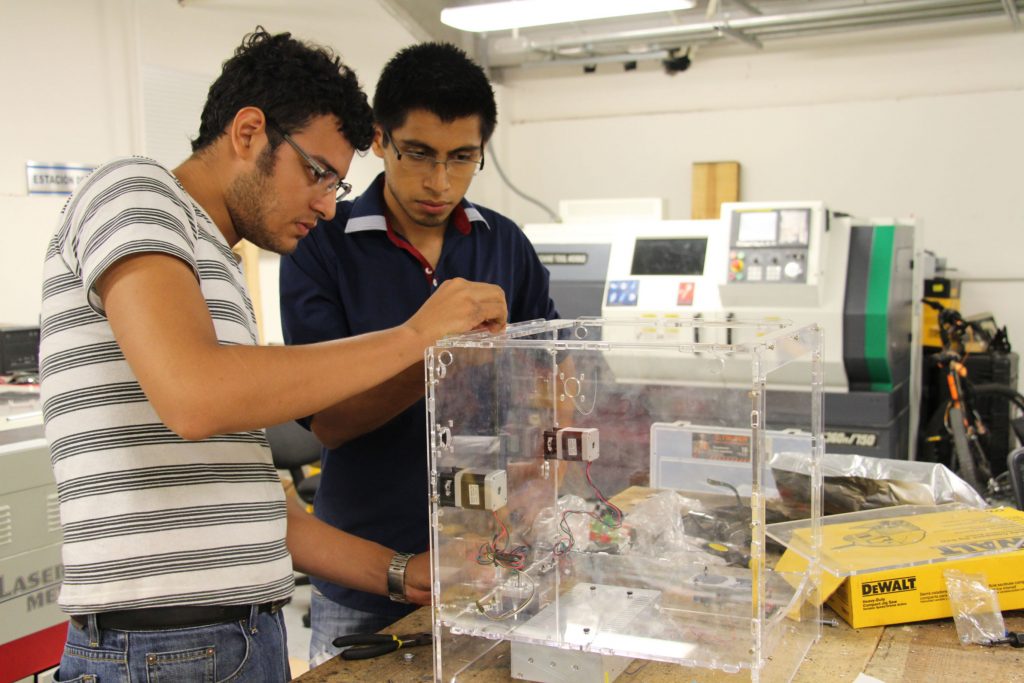
Students of the Autonomous University of Sinaloa (UAS, Universidad Autónoma de Sinaloa), who participate in the creation of prototypes at the Technological Innovation Park (PIT, Parque de Innovación Tecnológica), developed a systems that allows for recycling up to 70% of material used in 3D printings. Javier Eduardo Avitia Camacho, altogether with his schoolmates of UAS’ industrial processes and electronics engineering, became aware that PIT destined an important amount of resources to acquire 3D printing material, specifically ABS and PLA plastics. These youths decided to develop a system that permit to save material, so it could be reusable. They did, at the same time the projects they develop at PIT, some of which are technologies for local enterprises. Javier Avitia, for example, currently works on the prototype of a more versatile machine, this is, with bigger printing usefulness, for its use in the engineering and architecture sectors: a 3D blueprints, printed circuit boards, among others; all in the same machine. «We develop a 3D printer. Based on this one, we saw the necessity of recycling the printer’s wasted materials, given that if any piece is wrongly designed or in bot being used, it is thrown away, and is plastic material not being used at all and that just pollutes the environment. That is why we decided to do something about it. We decided to recycle those materials, which are thermoplastics and not so complicated to recycle», he commented. First, he said, they granulated the material, that was extruded after, so it could get back its raw material form, as it is used in 3D printers. «Like this, it is possible to use at least five times the same material. This is, we no longer throw away the material, we use it again in new prototypes», he commented. Even, he added, they devised that once the five cycles are accomplished it be possible to blend it with virgin material and reuse it once again. This has generated savings of 70% in the acquisition of printing material at PIT. «At PIT, we have four 3D printers. We use many plastic kilograms, and with this we are diminishing the material purchase. Virgin raw material, small chips, have a cost near to 100 pesos. If you put this virgin material, automatically realises the filament, which cost is of 500 pesos per reel», he explained. In the recycling process is included the material that, by some reason, did not work or that approved prototype that goes to higher-resistant material elaboration, ready for its commercialisation. The systems consists of two machines, two independent prototypes, among them is the plastic material recycler. Now, students work to make the whole system more compact, reducing the machine to a smaller size in order to look for its commercialisation. «We are also searching the system’s patent. This will be during the next months», said Javier Eduardo Avitia Camacho. Written by Janneth Aldecoa (Conacyt Information Agency), Translated by Belem Ruiz (Edition and Communication, PIT-UAS).
Artificial intelligence: from Turing test to the dream of emulating human brain

When we speak about artificial intelligence (AI), thanks to the characterisations of thinking and autonomous robots that Hollywood has given us, we keep a futurist and distant notion of metal beings emotionally sensible that represent the miracle of the creation formulated by the man’s bare hands. However, the reality is that we already get along with very common AI forms day-to-day: from videogames to web browsers, artificial intelligences have been helping us with our quotidian tasks for more than sixty years. The most well-known advances in this field of computing sciences have involved the development of data research and learning algorithms, as well as the incorporation of statistical analysis for the comprehension of the world on a broad scale. But these advances are perceived as subtle, from the perspective of a general public that still awaiting the arrival of a robot capable of chatting, either about spaceships self-drivign or about philosophical issues. But what are the AI? Some AI definitions According to the experts Stuart Russell (Computing Sciences professor at the University of California) and Peter Norvig (Research director at Google), the AI are classified in four types of systems. Below, we pick up the quotes included by Russell and Norvig in their prestigious book Artificial intelligence, a modern approach, currently used by over three thousand universities in more than one hundred and then countries. Systems that think like humans. John Haugeland (1985): «The exciting new effort to make computers think… machines with minds, in the full and literal sense». Richard Bellman (1978): «[The automation of] activities that we associate with human thinking, activities such as decision-making, problem solving, learning…». Systems that thinks rationally. Eugene Charniak y Drew McDermott (1985): «The study of mental faculties, through the use of computational models». Patrick Winston (1992): «The study of the computations that make it possible to perceive, reason, and act». Systems that act like humans. Raymond Kurzweil (1990): «The art of creating machines that perform functions that require intelligence when performed by people». Elaine Rich y Kevin Knight (1991): «The study of how to make computers do things at which, at the moment, people are better». Systems that act rationally. David Poole et alii (1998): «AI is the study of the design of intelligent computational agents». Nils Nilsson (1998): «AI… is related to intelligent behaviour on devices». Turing test and AI beginnings The first approach made on this subject was carried out by British mathematician Alan Turing in 1950, in his article «Computing machinery and intelligence», where he considered the possibility of creating machines capable of imitate human beings and their ability to realise tasks of intelligence or mental dexterity like, for example, playing chess. His main proposal was based on the matter of determining if computers, beyond their irrefutable skills to logical thinking, would be able to think. The Turing test derived from that work, picks up the imitation game explained by the mathematician in his text: two rooms, two persons, one computer; in a room, one person (interviewee 1) and the computer (interviewee 2); in the other room, the other person (interrogator) has the duty of distinguishing which one of the interviewees is human. Even though up to date the computer hasn’t been able to posing as a human being before another human being, the test still marking a parameter to follow during the coming years. Although with his pragmatic explanation from mathematics and philosophy about machines and their sensibility or «feeling» ability, Alan Turing was the first to open the door to research on artificial intelligences creation, it was not until 1956 when the term artificial intelligence was coined, when John McCarthy used it in his first academic conference on the subject. The progress in AI’s development A highly studied theme within AI area, when it comes to show the capabilities reached in its development, are software and machines created with the ability of defeating world champions in games like chess. In a certain way, this game of strategy and analysis has always been linked to the intelligence concept, event in Turing’s paper were suggested questions about chess moves for the machine to solve them. During over five decades of research, scientists have dreamed on creating a machine equipped with an interface able to think autonomously, with no need of human intervention at all; they still far from that goal. But, it should be clarified, the idea of creating an intuitive machine has its detractors, who stigmatize it as dangerous, impossible or strayed from AI’s original course. On his part, Marvin Minsky, one of the founders of this discipline, emphasises: «Great advances in artificial intelligence occurred between sixties and eighties of the last century. During the past years I have not seen anything that surprise me, because now founding is more focused on short term applications than basic science». Whereas Jeff Hawkins, in his book On Intelligence, highlights that computers went from being room-sized to be small enough to fit in a pocket in just half a century; since our starting point is technologically advanced, Hawkins predicts that the transition to intelligent machines will occur in less time. Another believer and visionary on predictions for the near future within AI is Raymond Kurzweil, Engineering director at Google: the creation of nanobots able to patrol the body’s physic and neuronal functioning, injected nanobots in human bloodstream that would later download the information in a supercomputer; neuronal data storage, by means of a software, could recreate a version of the human mind (memory, emotions and thoughts), that could be taken into other machines, which would act as the original person, creating like this an immortality notion. Current AI uses Google enterprise, after five years of development, has created a Lexus automobile capable of driving itself. Developers «taught» it how persons drive, driving rules and, thanks to devices installed in the car and an internet connexion, it can know routes, traffic flow and simulate what a human driver would do. Last moth, Sony announced two pop songs composed by AI. The
Inteligencia artificial: de la prueba de Turing al sueño de emular el cerebro humano
Cuando hablamos sobre inteligencia artificial (IA), gracias a las caracterizaciones de robots pensantes y autónomos que nos ha obsequiado Hollywood, nos quedamos con una noción futurista y lejana sobre seres de metal emocionalmente sensibles que representan el milagro de la creación formulada por las propias manos del hombre. Sin embargo, la realidad es que en nuestro día a día ya convivimos con formas de IA muy comunes: desde videojuegos hasta buscadores web, las inteligencias artificiales nos ayudan en nuestras tareas cotidianas desde hace más de sesenta años. Los avances más notorios en este campo de las ciencias computacionales han involucrado el desarrollo de algoritmos de búsqueda y aprendizaje de datos, así como la integración de análisis estadístico para la comprensión del mundo a gran escala. Mas estos avances se perciben sutiles, desde la perspectiva de un público general que aún aguarda la llegada de un robot capaz de charlar, ya sea sobre naves espaciales que se conduzcan solas o en torno a cuestiones filosóficas. ¿Pero qué son las IA? Algunas definiciones de las IA De acuerdo con los expertos Stuart Russell (profesor de Ciencias Computacionales en la Universidad de California) y Peter Norvig (director de Investigación en Google), las IA se clasifican en cuatro tipos de sistemas. A continuación retomamos las citas textuales que Russell y Norvig incluyen en su prestigiosos libro Inteligencia artificial, un enfoque moderno, actualmente usado por más de mil trescientas universidades en más de ciento diez países. Los sistemas que piensan como humanos. John Haugeland (1985): «El nuevo y excitante esfuerzo de hacer que los computadores piensen… máquinas con mentes, en el más amplio sentido literal». Richard Bellman (1978): «[La automatización de] actividades que vinculamos con procesos de pensamiento humano, actividades, como la toma de decisiones, resolución de problemas, aprendizaje…». Los sistemas que piensan racionalmente. Eugene Charniak y Drew McDermott (1985): «El estudio de las facultades mentales mediante el uso de modelos computacionales». Patrick Winston (1992): «El estudio de los cálculos que hacen posible percibir, razonar y actuar». Los sistemas que actúan como humanos. Raymond Kurzweil (1990): «El arte de desarrollar máquinas con capacidad para realizar funciones que cuando son realizadas por personas requieren de inteligencia». Elaine Rich y Kevin Knight (1991): «El estudio de cómo lograr que las computadoras realicen tareas que, por el momento, los humanos hacen mejor». Los sistemas que actúan racionalmente. David Poole y otros (1998): «La inteligencia computacional es el estudio del diseño de agentes inteligentes». Nils Nilsson (1998): «IA… está relacionada con conductas inteligentes en artefactos». La prueba de Turing y los inicios de las IA El primer planteamiento que se hizo sobre este tema se llevó a cabo por parte del matemático inglés Alan Turing en 1950, en su artículo «Computing machinery and intelligence», en el cual planteaba la posibilidad de crear máquinas capaces de simular a los seres humanos y su capacidad de realizar tareas de inteligencia o destreza mental como, por ejemplo, jugar ajedrez. Su planteamiento central se basaba en la cuestión de si los computadores, más allá de su irrefutable habilidad para el procesamiento lógico, serían capaces de pensar. De este trabajo derivó la prueba de Turing, que retoma el juego de la imitación planteado por el matemático en su texto: dos habitaciones, dos personas, una computadora; en una habitación una persona (interrogado 1) y la computadora (interrogado 2); en la otra habitación, la otra persona (interrogador) tiene la tarea de distinguir cuál de los dos interrogados es humano. No obstante hasta la fecha la computadora no ha podido hacerse pasar por un ser humano ante otro ser humano, la prueba sigue marcando un parámetro a seguir durante los años venideros. Aun cuando con su planteamiento pragmático desde las matemáticas y la filosofía acerca de las máquinas y su sensibilidad o capacidad «sintiente», fue Alan Turing el primero en abrir la puerta hacia la investigación sobre la creación de inteligencias artificiales, el término de inteligencia artificial no fue acuñado por la comunidad científica sino hasta 1956, cuando John McCarthy lo utilizó en su primera conferencia académica sobre el tema. El avance en el desarrollo de las IA Un tema muy estudiado en el área de las IA, cuando se trata de mostrar las capacidades alcanzadas en su desarrollo, son los softwares y máquinas creados con la habilidad de derrotar a campeones mundiales en juegos como el ajedrez. De cierta manera, este juego de estrategia y análisis siempre se ha visto ligado con el concepto de inteligencia, e incluso en el trabajo de Turing se planteaban preguntas sobre movimientos de ajedrez para que la máquina los resolviera. Durante más de cinco décadas de investigación, los científicos han soñado con la creación de una máquina equipada con una interfaz capaz de pensar autónomamente, sin necesidad de intervención humana alguna; aún se encuentran lejos de esta meta. Aunque, cabe aclarar, la idea de crear una máquina intuitiva tiene sus detractores, quienes la tildan de peligrosa, imposible o desviada del curso original de las IA. Por su parte, Marvin Minsky, uno de los fundadores de la disciplina, señala: «Los grandes avances en inteligencia artificial se dieron entre los sesenta y los ochenta del pasado siglo. En los últimos años no he visto nada que me sorprenda, porque ahora la financiación se enfoca más en aplicaciones de corto plazo que en ciencia básica». En tanto, Jeff Hawkins, en su libro On Intelligence, destaca que tan sólo en medio siglo las computadoras pasaron de ser del tamaño de una habitación a ser tan compactas como para caber en el bolsillo; como estamos comenzando desde un punto de inicio tecnológicamente avanzado, Hawkins predice que la transición a máquinas inteligentes sucederá en menor tiempo. Otro creyente y visionario en las predicciones para el futuro cercano dentro de las IA es Raymond Kurzweil, director de Ingeniería de Google: la creación de nanobots capaces de patrullar el funcionamiento físico y neuronal del cuerpo, que serían inyectados en la corriente sanguínea de los humanos, para luego descargar la información en una supercomputadora; el almacenamiento de la información neuronal podría recrear en un software una versión de la mente
Challenge 10: Sinaloense youth in pursuit of scientific-technological innovation
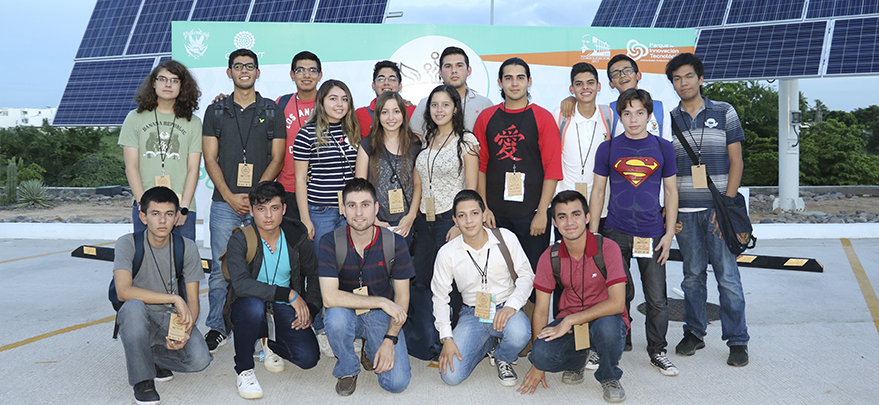
With enthusiastic spirit and lots of energy, this Friday 30th September was started Challenge 10, as part of the programmed activities for TechnoCamp 2016. The chosen youths were convened at 9:00 a. m. at the facilities of our scientific-technological university park, where they would develop the dynamic’s diverse activities during the day, concluding at 7:00 p. m. PhD Inés Vega López and MSc Rogelio Prieto Alvarado gave the inaugural welcome to participants, both of them were juries of the competence and are current collaborators at the Technological Innovation Park (PIT) belonging to the Autonomous University of Sinaloa (UAS). Vega López wished success to all of the selected ones gathered at Training Room and invited them to take interest in PIT-UAS, an open space for youths to strengthen their scientific vocations. For his part, Prieto Alvarado classified this kind of events as an «incentive so their interest [youths’] remain and can be boosted». It was told to technocampers that they would have 10 hours to live the experience of facing the not so easy challenge of strategizing a scientific-technological solution for problems pre-established by organizers, based on real entrepreneurial an social necessities. For these potential future researchers, Challenge 10 represents an open door to inspiration, which invites them to enquire into ways of solving social problems through scientific-technological innovation, as well as being part —over the next years— of research and development centres as the PIT-UAS itself. Since the beginning of the event, an atmosphere of camaraderie was breathed among all the participants, each of which was chosen by the following criteria: being high school or university students, have competed in knowledge olympiads or prototypes contests and have been subscribed by means of the online application for TechnoCamp. Those who had these qualifications were candidates for being randomly selected, any of them could take one of the 16 available posts in the competition (although, given the great attendance to TechnoCamp, this number of posts had to be increased to 19). Many of these students talked with us about their motivations to approach to science, some of them begun with curiosity to go towards physics or mathematics since an early age, they saw it as a way to obtain answers to their unanswered questions about the world; others started going in depth into hard sciences through their participation in academic contests or thanks to testimonies given by people involved in these study fields. All the tecnocampers, even though their stories are different, have common vision: do their bit, contributing to change and to improve the world through their knowledge. By counselling and support, the event has the objective of helping them to accomplish this shared dream. Challenge 10 dynamic consisted of dividing the 19 participants in four teams, each of which would solve a specific problem through the elaboration a project proposal including the plan of a prototype. The problems to be treated belonged to fields like precision agriculture, renewable energies and sustainability, mobility and transportation, besides public security. Each of these proposals would contribute to the resolution and improvement within the assigned area; the winner team will have the opportunity of realising its project’s prototype within the PIT-UAS’ facilities, with its researchers and professionals’ specialised guidance, supplemented by institutional financing support. As part of the counselling, each team passed by the Park’s distinct workshops and laboratories, where was given to them an outlook of what this university organizational unit is capable of doing in the matter of robotics, bioinformatics, physics, renewable energies, software development, automation, 3D printing and other industries of the future that are worked on within the facilities, thanks to material and human resources that the PIT-UAS has. Technocampers could lay out specific questions regarding to the problem they were told to resolve, doubts that were answered by people in charge of the visited areas. In this way, the 19 youths joined the synergy each day is carried out at our facilities, where coincide different knowledge areas in search of resolving social problems. The duration in each laboratory was of about thirty minutes, so this part of the event lasted a little bit more than two hours. Afterwards, the contestants had a break for lunch, socialising and getting to know each other better, in this pleasant and innovator space, surrounded by scientific-technological prototypes and highly specialised machinery than in the future might become their quotidian scene. Finally, the participants delivered their projects to the jury. Evaluators members analysed, one by one, the projects, taking into account as evaluation parameters technical and financial feasibility of the proposal, grade of innovation it represented, economic, social, environmental and scientific impact, multidisciplinarity and the realisation time it would take. After a little more than an hour and a half of deliberation, following the intense research and learning day lived by the participants, the juries selected one proposal as the winner. The evaluating jury was conformed of PhD Ildefonso Léon Monzón (full-time principal professor-researcher C at UAS’ Physic-Mathematics Sciences Faculty and responsible of PIT-UAS’ Electronics Instrumentation and Radiation Detectors Laboratory), PhD Bianca Amézquita López (principal professor-researcher B at UAS’ Chemical-Biological Sciences), PhD Inés Vega López (responsible of PIT-UAS’ Bioinformatics Laboratory), PhD Carlos Duarte Galván (professor-researcher at UAS’ Physic-Mathematics Sciences Faculty) and MSc Rogelio Prieto Alvarado (PIT-UAS’ operative coordinator). Thus, during the closing ceremony, that took place at Smart Eco-Park, the Seeds-Flux Sensor for Traditional Sowings to Obtain Greater Precision in Agricultural Consumables Distribution. First place winners were received with huge ballyhoo: Emmanuel Guillermo Rojas Márquez and José Francisco Espinoza Soto (UAS’ Physic-Mathematics Sciences Faculty), Martín Darel Lugo Leyva (UAS’ Biology School), Norma Guadalupe Rodríguez Aguilar (Jean Piaget del Río Institute) and Héctor Omar Salazar Obeso (UAS’ Dr. Salvador Allende pre-university academic unit). It was particularly moving to see these five technocampers gathering in a group embrace when they were declared winners, celebrating like this the recognition to their efforts and the obtained opportunity, fruit of their perseverance and interest in matters of science, technology and innovation. In the words of PIT-UAS’ general director: «It is
Reto 10: la juventud sinaloense en búsqueda de la innovación científico-tecnológica
Con espíritu de entusiasmo y mucha energía, dio inicio este viernes 30 de septiembre el Reto 10, como parte de las actividades programadas dentro del TecnoCamp 2016. Los jóvenes seleccionados fueron convocados a las 9:00h en las instalaciones de nuestro parque científico-tecnológico universitario, donde durante el día desarrollarían las diversas actividades de la dinámica, para concluir a las 19:00h. La bienvenida inaugural para los participantes estuvo a cargo del doctor Inés Vega López y el c. M. C. Rogelio Prieto Alvarado, colaboradores del Parque de Innovación Tecnológica (PIT) de la Universidad Autónoma de Sinaloa (UAS) y jurados de la competencia. Vega López deseó éxito a los seleccionados reunidos en el Aula de Capacitación y los invitó a acercarse al PIT-UAS, espacio abierto para que los jóvenes fortalezcan sus vocaciones científicas. Por su parte, Prieto Alvarado catalogó esta clase de eventos como un «aliciente para que el interés [de los jóvenes] permanezca y se impulse». Se explicó que los tecnocamperos tendrían 10 horas para vivir la experiencia de afrontar el nada fácil reto de plantear una solución científico-tecnológica para problemáticas prestablecidas por los organizadores, basadas en necesidades empresariales y sociales reales. Para estos posibles futuros investigadores, Reto 10 representa una puerta abierta a la inspiración, que los invita a indagar en maneras de solucionar problemáticas sociales a través de la innovación científico-tecnológica, así como a formar parte, en los próximos años, de centros de investigación y desarrollo como el propio PIT-UAS. Desde el comienzo del evento se respiraba un ambiente de camaradería entre todos los participantes, cada uno de los cuales fue seleccionado bajo los siguientes criterios: ser estudiante de nivel medio superior o superior, haber competido en olimpiadas del conocimiento o en concursos de prototipos y haberse inscrito a través de la solicitud en línea para el TecnoCamp. Quienes cumplieran con estos requisitos eran candidatos para ser seleccionados al azar, cualquiera de ellos podría tomar uno de los 16 lugares disponibles en el certamen; número de puestos que, dada la gran afluencia con la que contó TecnoCamp, debió ascenderse a 19. Muchos de estos jóvenes conversaron con nosotros sobre sus motivaciones para aproximarse a la ciencia, algunos de ellos comenzaron con curiosidad a acercarse a la física o las matemáticas desde una edad temprana, lo veían como una forma de obtener respuestas a sus interrogantes sobre el mundo; otros iniciaron su adentramiento a las ciencias duras a través de participaciones en concursos académicos o gracias a testimonios de personas involucradas en estos campos de estudio. Todos los tecnocamperos, aun cuando sus historias seas distintas, tienen una visión en común: poner su granito de arena, contribuir a cambiar y mejorar el mundo a través de sus conocimientos. El evento tiene como fin ayudarlos, a través de asesoría y apoyo, a cumplir este sueño compartido. La dinámica del Reto 10 consistió en dividir a sus 19 participantes en cuatro equipos, cada uno de los cuales resolvería una problemática de un tema específico a través de la elaboración de una propuesta de proyecto que incluyera el planteamiento de un prototipo. Las problemáticas a tratar pertenecían a campos como agricultura de precisión, energías renovables y sustentabilidad, movilidad y transporte, además de seguridad pública. Cada una de estas propuestas contribuiría a la resolución y la mejora en el área asignada; el equipo ganador tendrá la oportunidad de realizar el prototipo de su proyecto en las instalaciones del PIT-UAS, con la guía especializada de sus investigadores y profesionistas, adicionado con el apoyo financiero institucional. Como parte de la asesoría, cada equipo pasó por los distintos laboratorios y talleres del Parque, donde les fue dado un panorama de lo que esta unidad organizacional universitaria es capaz de hacer en materia de robótica, bioinformática, física, energías renovables, desarrollo de software, automatización, impresión 3D y demás industrias del futuro que se trabajan en las instalaciones, gracias a los recursos materiales y humanos con los que cuenta el PIT-UAS. Los tecnocamperos pudieron plantear preguntas específicas respecto a la problemática que les fue encomendada resolver, dudas que fueron atendidas por los encargados de las áreas visitadas. De esta manera, los 19 jóvenes se sumaron a la sinergia que día a día se lleva a cabo en nuestras instalaciones, donde convergen distintas áreas del conocimiento en búsqueda de solucionar problemas sociales. La duración en cada laboratorio fue de alrededor de treinta minutos, lo que hizo que esta parte del evento durara poco más de dos horas. Después, los concursantes tuvieron un descanso para comer, socializar y conocerse mejor, en este ameno espacio innovador, rodeados de prototipos científico-tecnológicos y maquinaria de alta especialización que bien podrían llegar se escenario cotidiano en un futuro. Finalmente, los jóvenes participantes entregaron sus proyectos al jurado. Los miembros evaluadores analizaron, uno por uno, los proyectos, tomando en cuenta como parámetros de aprobación la factibilidad técnica y financiera de la propuesta, el grado de innovación que presentaba, el impacto económico, social, ambiental y científico, la multidisciplinariedad y el tiempo de ejecución que tomaría. Tras poco más de hora y media de deliberación, después de la intensa jornada de investigación y aprendizaje vivida por los participantes, los jurados seleccionaron una propuesta como ganadora. El jurado evaluador estuvo conformado por el doctor Ildefonso León Monzón (profesor investigador titular C de tiempo completo en la Facultad de Ciencias Físico-Matemáticas de la UAS y responsable del laboratorio Instrumentación Electrónica y Detectores de Radiación del PIT-UAS), la doctora Bianca Amézquita López (profesora investigadora titular B de la Facultad de Ciencias Químico-Biológicas de la UAS), el doctor Inés Vega López (responsable del Laboratorio de Bioinformática del PIT-UAS), el doctor Carlos Duarte Galván (profesor investigador de la FCFM-UAS) y el c. M. C. Rogelio Prieto Alvarado, coordinador operativo del PIT-UAS. Así, durante el evento de clausura, realizado en el Smart Eco-Park, se anunció como proyecto ganador el Sensor de Flujo de Semillas en Sembrados Tradicionales para una Mayor Precisión en la Distribución de Insumos Agrícolas. Con gran algarabía se recibió a los ganadores del primer lugar: Emmanuel Guillermo Rojas Márquez y José Francisco Espinoza
Se inaugura en Torre Académica de la UAS la primera edición del TecnoCamp
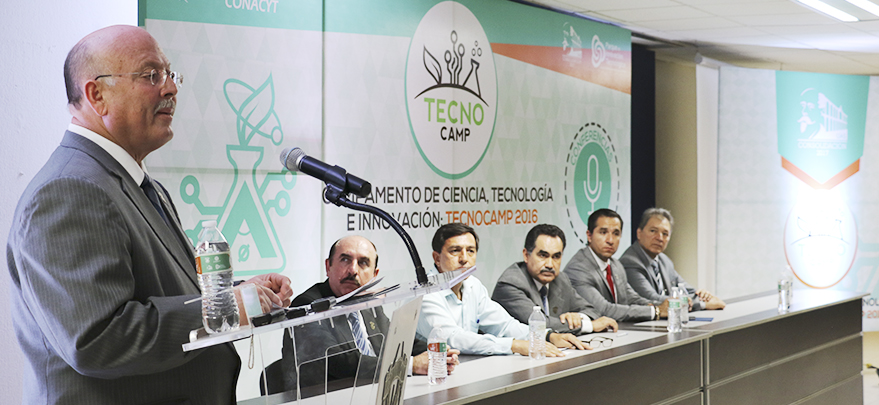
Este jueves 29 de septiembre, en el marco de la convocatoria federal denominada Programa de Fomento a las Vocaciones Científicas y Tecnológicas en Niños y Jóvenes Mexicanos, promovida por el Consejo Nacional de Ciencia y Tecnología, el rector de la Universidad Autónoma de Sinaloa (UAS), doctor Juan Eulogio Guerra Liera, inauguró junto con el director general del Parque de Innovación Tecnológica (PIT), maestro José Ramón López Arellano, la primera edición del Campamento de Ciencia, Tecnología e Innovación, TecnoCamp 2016, evento que busca fomentar las vocaciones científico-tecnológicas de los jóvenes sinaloenses de nivel medio superior y superior. A la inauguración del evento asistieron diversas personalidades, así directores de distintas unidades académicas, como representantes de las áreas de ciencia y tecnología del estado. También se contó con la presencia de más de 500 jóvenes talentos universitarios y bachilleres provenientes de diferentes unidades académicas del estado, tanto de la UAS como de otros centros educativos (Universidad Politécnica de Sinaloa, Instituto Jean Piaget del Río, Instituto Tecnológico de Sonora, Instituto Tecnológico de los Mochis, etc.). El primer día de actividades comenzó con tres conferencias impartidas en la Sala de Usos Múltiples por doctores invitados al evento, científicos e investigadores pertenecientes a diversas áreas del conocimiento cuyo trabajo cuenta con reconocimiento nacional e internacional: Ricardo Hugo Lira Saldívar (investigador titular C del Centro de Investigación en Química Aplicada), José Martínez Carranza (coordinador de Ciencias Computacionales del Instituto Nacional de Astrofísica, Óptica y Electrónica), Ildefonso León Monzón (responsable del detector ALICE en el Centro Europeo para la Investigación Nuclear). Los conferencistas hablaron a los presentes sobre temas relacionados con industrias del futuro, como los drones y la nanotecnología, además de la investigación de frontera. Al reunir a estos especialistas para que lleven su mensaje a los jóvenes talentos asistentes, el PIT-UAS busca contribuir a lo estipulado en el eje 2 del Plan de Desarrollo Institucional Consolidación 2017, en materia de llevar a cabo la producción, el uso y la distribución del conocimiento por medio de la estrategia de impulsar el espíritu científico de la comunidad estudiantil. La próxima semana publicaremos en nuestras redes sociales algunas cápsulas sobre estas tres conferencias magistrales. Por último, es preciso retomar algunas palabras de López Arellano: «Con eventos como el TecnoCamp se estimulan la inteligencia colectiva y las vocaciones científicas, para que así estos jóvenes se conviertan en catalizadores de la sociedad del conocimiento». Por su parte, Guerra Liera destacó: «uno de los retos más grandes que tiene un país que aspire a consolidarse como desarrollado es la innovación tecnológica, que marca el futuro que se tiene de la misma forma en las instituciones de educación superior». «En la Universidad Autónoma de Sinaloa queremos manifestar la alianza con el futuro tecnológico y es así, por medio de instituciones como CONACYT que lo hemos venido desarrollando». Fuente: Comunicación Social PIT-UAS.
TecnoCamp’s first edition is inaugurated at UAS’ Academic Tower
This Thursday 29th September, within the framework of the federal call denominated Encouragement to Scientific Vocation in Mexican Children and Youths Programme, promoted by the National Council of Science and Technology (Conacyt, Consejo Nacional de Ciencia y Tecnología), the rector of the Autonomous University of Sinaloa (UAS, Universidad Autónoma de Sinaloa), PhD Juan Eulogio Guerra Liera, inaugurated together with the general director of the Technological Innovation Park (PIT), MBA José Ramón López Arellano, Science, Technology and Innovation Camp’s first edition, TecnoCamp 2016, an event that aims to boost scientific-technological vocations of Sinaloense youths of high schools and universities. Diverse personalities attended to the event’s inauguration, directors of different academic units and representatives of science and technology in the state. Also attended over five hundreds of young university and high school talents belonging to different academic units of the entity, both UAS and other educative centres (Polytechnic University of Sinaloa, Jean Piaget del Río Institute, Sonora Institute of Technology, Los Mochis Technological Institute…). The first day of activities started with three conferences imparted at the Multiple Usages Hall by doctors invited to the event, scientists and researchers of diverse areas of knowledge which work has national and international recognition: Ricardo Hugo Lira Saldívar (C principal investigator, Applied Chemistry Research Centre), José Martínez Carranza (Computing Sciences coordinator at the National Institute of Astrophysics, Optics and Electronics) and Ildefonso León Monzón (ALICE detector responsible at the European Centre for Nuclear Research). Lecturers spoke to the attendees about themes related to industries of the future, like drones and nanotechnology, besides frontier research. By gathering these specialists so they can bring their message to young talents, PIT-UAS seeks to contribute to what is stipulated within the axis 2 of the Plan of Institutional Development Consolidation 2017, in the matter of carrying out the production, usage and distribution of knowledge by means of the strategy of motivating scientific spirit among student community. Next week we will publish video clips about these three lectures in our social networks. Ultimately, is worth recalling some words said by López Arellano: «With events like TecnoCamp collective intelligence and scientific vocations are stimulated, so these youths become knowledge society’s catalyst». For his part, Guerra Liera emphasised: «… one of the greatest challenges for a country that aims to consolidate itself as a developed one is technological innovation, which marks the future we have in the same way higher education institutions do… At the Autonomous University of Sinaloa we want to express the alliance with the technological future, and it has been through institutions like Conacyt that we have been developing it». Written by Moroni Arellano (Diffusion, PIT-UAS). Translated by Belem Ruiz (Edition and Communication, PIT-UAS).
Prototype elaborated by PIT-UAS collaborators wins first place in Mechatronics, within IV EJIS framework
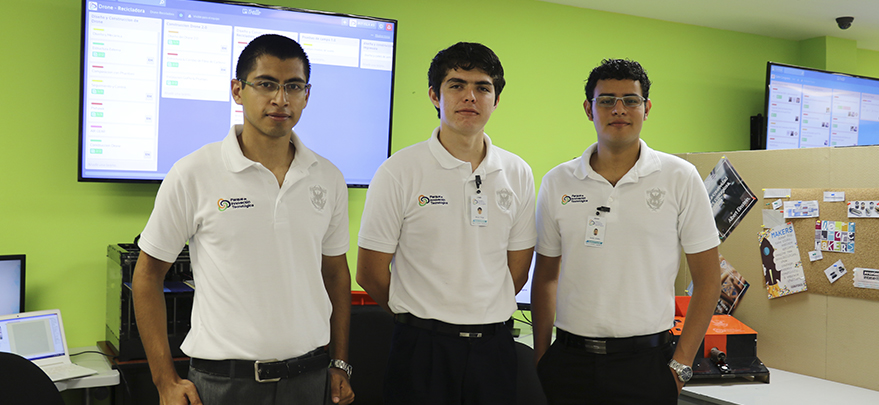
In representation of the Autonomous University of Sinaloa (UAS, Universidad Autónoma de Sinaloa), through its Technological Innovation Park (PIT, Parque de Innovación Tecnológica), Eduardo Abitia participated, the 21st and 22nd September, in the prototypes fair of the IV Sinaloa Estate Young Researchers Encounter (EJIS, Encuentro de Jóvenes Investigadores del Estado de Sinaloa), where his Recycler of Plastic Material for 3D Print received the first place within its category. This year EJIS, which is support by the National Council of Science and Technology, the Institute for the Support of Research and Innovation of Sinaloa and the Sinaloa State Government, was carried out in the Conventions Centre’s facilities at Mazatlán city and was organized by the Polytechnic University of Sinaloa, in association with other higher education institutions and public research centres of Sinaloa. The participation of PIT-UAS young collaborator consisted of explaining recycler’s functioning and making some demonstrations of the prototype. The youth emphasized that the problematic attended by the device is an ecological issue: 3D print is one of the industries of the future, is starting to experience a boom and it is expected to grow even more during the next decade, unfortunately this technology’s waste (resin, polyamides, acrylonitrile butadiene styrene) is too much and highly contaminant. Eduardo spoke about the advantages of reusing plastic materials, economic and material resources maximization, recycling process and environmental impact generated by implementing this system (grinder and extruder). He also shared with the attendees how the interest in taking to practice what is learnt in the classroom, took him and his two schoolmates to the development of these two machines, which were preceded by a low cost and high performance 3D printer. This group of entrepreneurs students that made the three prototypes is conformed by two students of Industrial Processes Engineering belonging to the UAS’s Engineering Faculty, Javier Eduardo Abitia Camacho (9th semester) and Jesús Alberto Vega López (7th semester), as well as Juan Francisco Verdugo Arredondo (7th semester), student of Electronics at UAS’s Physics-Mathematics Sciences Faculty. Since April 2015, these three youths have developed their prototypes within PIT-UAS facilities, where they have fund tools, spaces and specialised counselling required in order to perfect their machines. Nowadays, they work in the design of a computer numeric control machine that allows to user assemble and disassemble different tools carriages, so the same structure can work the same for a laser cutting-machine, a 3D printer or a milling machine. Written and translated by Belem Ruiz (Edition and Communication, PIT-UAS).
Prototipo elaborado por colaboradores del PIT-UAS gana primer lugar en Mecatrónica, en el marco del IV Encuentro de Jóvenes Investigadores del Estado de Sinaloa
En representación de la Universidad Autónoma de Sinaloa (UAS), a través de su Parque de Innovación Tecnológica (PIT), Eduardo Abitia participó, los días 21 y 22 de septiembre, en la feria de prototipos del IV Encuentro de Jóvenes Investigadores del Estado de Sinaloa (EJIS), donde su Recicladora de Material Plástico para la Impresión 3D se hizo acreedora al primer lugar. Este año el EJIS, que cuenta con el apoyo del Consejo Nacional de Ciencia y Tecnología, el Instituto de Apoyo a la Investigación e Innovación de Sinaloa y el Gobierno del Estado de Sinaloa, se llevó a cabo en las instalaciones del Centro de Convenciones de la ciudad de Mazatlán y fue organizado por la Universidad Politécnica de Sinaloa, en conjunto con instituciones de educación superior y centros públicos de investigación sinaloenses. La participación del joven colaborador del PIT-UAS consistió en explicar el funcionamiento de la recicladora y hacer demostraciones del prototipo. El joven hizo hincapié en que la problemática que el artefacto pretende atender es de orden ecológico: la impresión 3D es una de las industrias del futuro, está comenzando a tener auge y se espera que se crezca aún más durante la próxima década, desafortunadamente el desecho (resinas, poliamidas, acrilonitrilo butadieno estireno) que esta tecnología deja es mucho y es altamente contaminante. Eduardo habló sobre las ventajas de reutilizar materiales plásticos, la maximización de recursos materiales y económicos), el proceso de reciclaje y el impacto ambiental que se genera al implementar este sistema (trituradora y extrusora). Además compartió con los asistentes el cómo su interés por llevar a la práctica lo aprendido en el aula, los llevó a él y a sus dos compañeros a realizar estas dos máquinas, a las que antecedió una impresora 3D de bajo costo y alto rendimiento. El equipo de estudiantes emprendedores que realizaron los tres prototipos está conformado por dos estudiantes de la ingeniería en Procesos Industriales de la Facultad de Ingeniería de la UAS, Javier Eduardo Abitia Camacho (9no semestre) y Jesús Alberto Vega López (7mo semestre), así como el alumno Juan Francisco Verdugo Arredondo de la licenciatura en Electrónica de la Facultad de Ciencias Físico-Matemáticas (7mo semestre) de la UAS. Desde abril de 2015, estos tres jóvenes han desarrollado sus prototipos en las instalaciones del PIT-UAS, donde se les han facilitado las herramientas, los espacios y la asesoría especializada requeridos para perfeccionar sus máquinas. Hoy día, trabajan en el diseño de una máquina de control numérico computarizado que permita al usuario montar y desmontar carretes de herramientas para que la misma estructura sirva lo mismo para una cortadora láser que para una impresora 3D o una fresadora. Fuente: Comunicación Social PIT-UAS.
Precision agriculture, technological innovation for crops
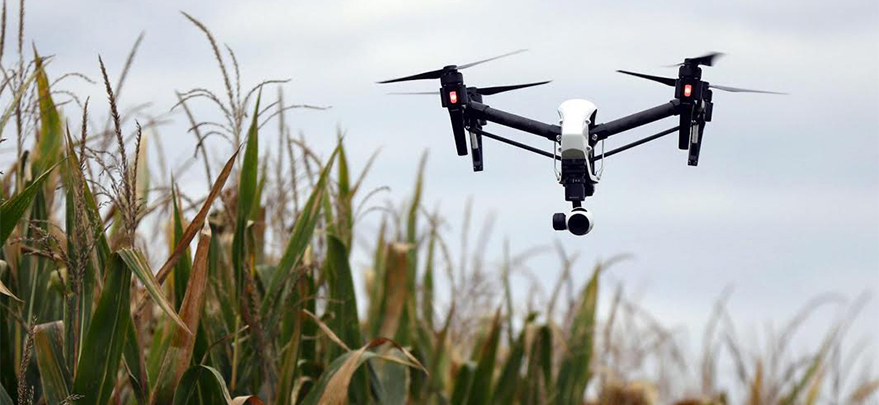
Precision agriculture consists of increasing resources exploitation and diminishing pollution effects through the employment of current technological tools, especially those related to geographical referencing of sites by satellites, which allows to take as management unit smaller areas than those used by traditional methods; such sites are liked to information databases, as support for decision making. In few words, consists in intervening accurately in the accurate place and moment, making the most out of the precision given nowadays by information technologies. Precision agriculture constitutes an instrument to diagnose with accuracy agricultural production problems, to make decisions and to obtain satisfactory answers in the indexes of agricultural performance, mainly though technologies as global positioning systems (GPS), sensors, satellites and aerial images, along with geographic information systems (GIS); as a whole, they allow for estimating, evaluating and understanding such variations. Recollected information is used for the highly accurate evaluation of the crop’s optimal density, estimating fertiliser and other required inputs usage, as well as higher-precision predicting of crops production. There is an application of this technology that is highly spread all over the fields: site-specific, methodology that has been used since this primary sector activity’s beginning, but it had a huge economic boost during agriculture mechanization in the 20th century, in order to work large cropland extensions with uniform agricultural practices. Site-specific technology makes possible to match seeds, fertilisers, pesticides and other agrochemical doses with soil type and other conditions. GPS is an instrument that allows to elaborate geographical maps much more detailed, this digital technology enables farmers to capture data about their croplands, in a way that their particular spatial characteristics can be examined, contrary to what happens within traditional paradigm, that used to analyse them as if they were homogeneous areas. At present, thanks to GPS, the days of square kilometre-based labour in fields has been left behind, now the labour is square metre-based. There are different methods to incorporate this technology in agricultural crops, an example is the one presented in the image, which shows a diagram of the site-specific technology cycle, divided in two phases: field evaluation and data application. First phase begins with the harvest guided by a performance monitor and a GPS (showing variability of each sector), then data is analysed with GIS and statistical software, which allows to give specific recommendations for each site; second phase begins with recommendations application, then comes customized sowing and fertilisation for each site, followed by plagues and diseases control (that also varies according to each site characteristics), finally is realised variable fertilisation; and the cycle restarts. Having said that, the implementation of a new technology always has social repercussions, and precision agriculture case is not the exception, initial resistance to change can be found in all sectors, no matter the benefits brought by technological innovation to that sector where it is established. Within this context, the precision agriculture disadvantage is that it did not rise up as a necessity of small producers, but rather it were transnational producers which imposed such technological innovation in the market. Although the rejection expressed by smallholdings to the implementation of scientific advances is matter that has been transcended by a great number of cases where technology has brought greater efficiency and productivity to agricultural fields. Lastly, it is worth noting that, in Latin-American countries like Cuba, adopting these new technologies has caused the following changes: performance is risen, costs are diminished, workforce is diminished, a quantitative leap in agriculture is caused up to levels of any highly developed industrial process, it is guaranteed a better environmental care, the quality of countryside life is increased. Agriculture is one of the most important productive sectors in our country and Sinaloa state is called Mexico’s Breadbasket, given that is one the states with better performances in this matter at a national level. In entities with an economic profile like ours, is of utmost importance incorporating technology based innovative solutions in agricultural processes, because they guarantee a quality and production increase that has an effect on regional socioeconomic improvement. Written by Alfredo Careaga (Communication, PIT-UAS), translated by Belem Ruiz (Edition and Communication, PIT-UAS).